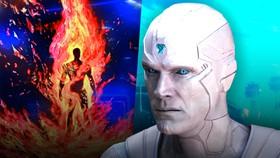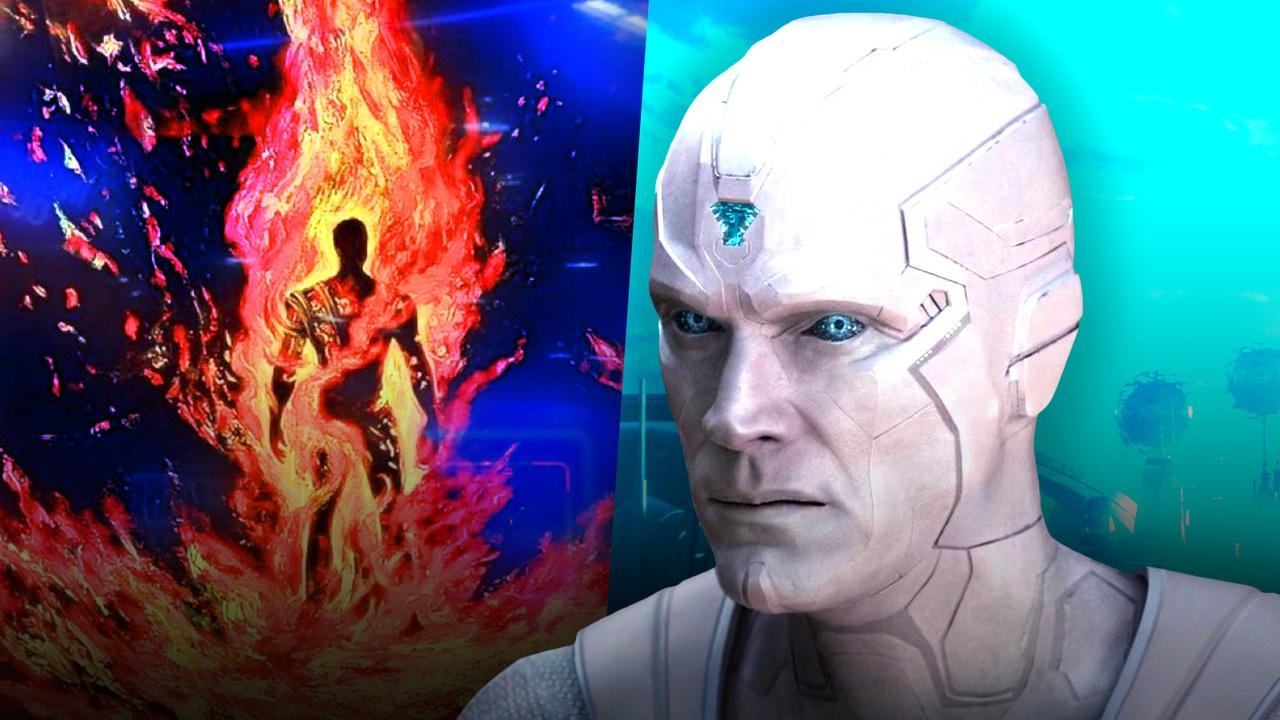
A new VisionQuest promo has revealed the best look yet at Jim Hammond, the original Human Torch from the Golden Age of Marvel Comics. The footage arrives shortly after the show's two-episode premiere on October 13, confirming the iconic character's place in the series. There had been a couple of teases of Hammond's presence, but it was never 100 percent clear he would actually feature. A previous promo showed a man on fire, hinting at him, but his facial features were kept out of view, leaving room for doubt.
Marvel Studios released the new promo on October 16, and it is packed with mind-bending footage. It opens with Paul Bettany's Vision in human form inside his Mindspace, where a figure at a receptionist desk hurls a metal object at him. The object phases through Vision's synthetic body, and he gears up to fire a blue energy blast before the camera cuts to James Spader's Ultron in human form. What follows is a flurry of shots of a synthetic Ultron and Vision, the latter in his new green, gold, and red suit, trading blows.
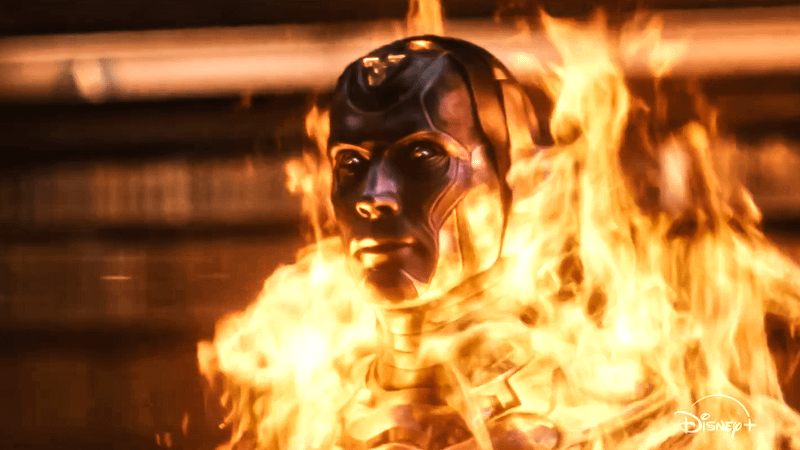
A rapid-fire montage then cycles through characters like Tommy Maximoff and T'Nia Miller's Jocasta before landing on the shot that has Marvel fans talking: an HD look at Jim Hammond's Human Torch. He appears in synthetic form, his body covered in dark metallic plating that sweeps across his crown, with a small crest at the center of his forehead.
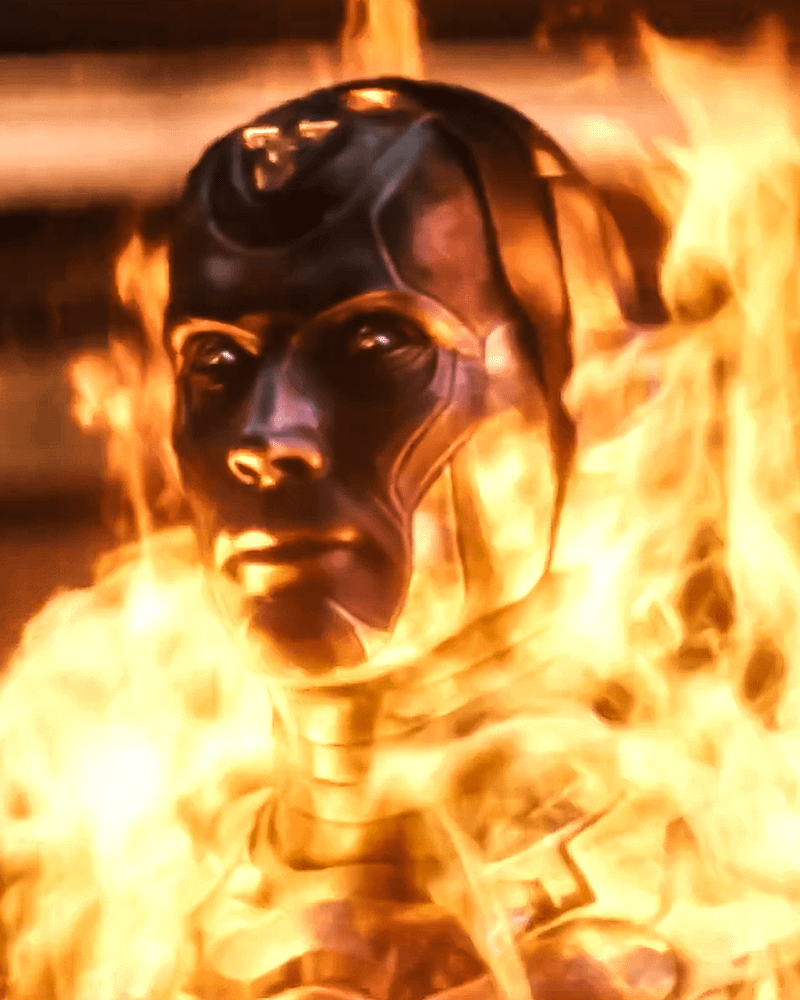
The design is well done, right down to the fine seams along his cheeks and jaw. His eyes look dark and ominous as flames engulf his entire body, making him all the more intimidating. The wood-paneled wall behind him indicates he exists inside Vision's Mindspace, just like the other AI creations in the series.
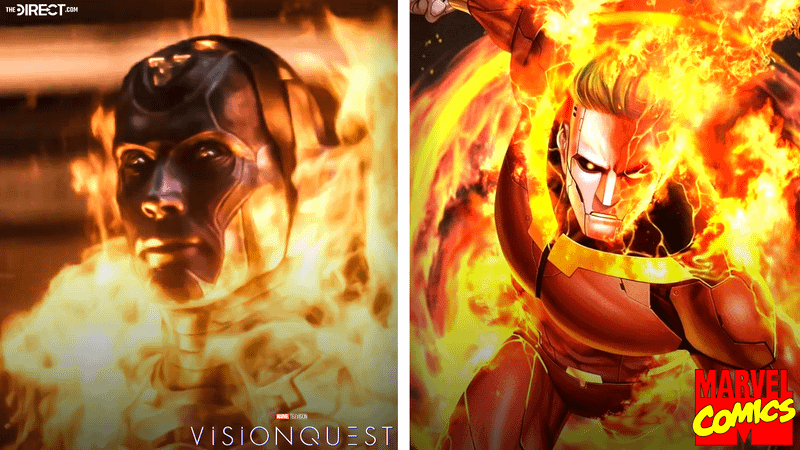
For those unfamiliar with Jim Hammond, he is one of the oldest superheroes in Marvel history. Created by Carl Burgos, he debuted in Marvel Comics #1 in 1939, sharing the issue with Namor the Sub-Mariner, back when Marvel still operated under the name Timely Comics. He technically made his MCU debut long before this show. His suit appeared on display at the 1943 Stark Expo in Captain America: The First Avenger, labeled "Synthetic Man."
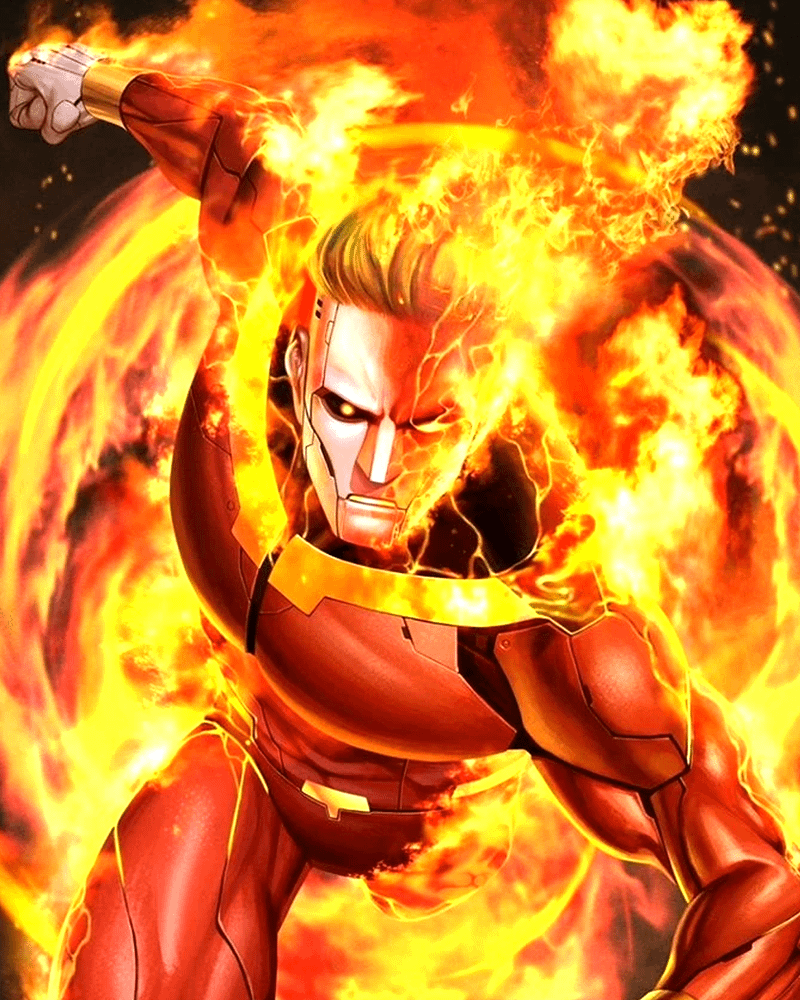
In the comics, scientist Phineas T. Horton built Hammond as a synthetic man, but a design flaw caused the android to burst into flames whenever his skin came into contact with oxygen. The character eventually became a hero, fighting alongside icons like Captain America and Bucky Barnes as a member of the Invaders. Stan Lee and Jack Kirby later recycled the name and powers for the Fantastic Four's Johnny Storm, who is otherwise unrelated to Hammond.
Why is Jim Hammond Integral to VisionQuest's Story?
So far, every AI or synthetic creation teased or introduced in VisionQuest has a deep connection to Vision or Ultron, and Hammond is no different. In the comics, Ultron built Vision, an idea the MCU adapted in its own way, but the source material tells it very differently. On the page, Ultron created the Vision from the remains of the original Human Torch, with Hammond's body literally becoming the foundation of the Avenger, a reveal dating back to The Avengers #57 in 1968.
The show's first two episodes have already nodded to that origin. In Episode 2, James D'Arcy's JARVIS warns Vision about the dangers of emotion, calling feelings "beautiful" but also "rash, impulsive, self-destructive," adding, "he knew that better than any of us," as the camera settles on the painting of a burning man. Vision then says of the figure, "As the first of us, he remains a cautionary tale, a reminder of what may become of me should emotions consume me."
The entire premise of VisionQuest is Vision trying to understand his origins, which is why Tony Stark's AIs, such as EDITH, JARVIS, and FRIDAY, exist in his Mindspace, with each tied to where he came from. The show is likely leaning heavily into Hammond's history, and it could prove key to Vision finally understanding his own.
Geraldo Amartey is a writer at The Direct. He joined the team in 2025, bringing with him four years of experience covering entertainment news, pop culture, and fan-favorite franchises for sites like YEN, Briefly and Tuko.