
Happy Death Day and Pulse star Jessica Rothe has a new sci-fi body-horror movie just around the corner, hitting theaters on Friday, May 8, and it offers a harrowing deep dive into morality and grief. The film follows Rothe's Ellie, a woman who wakes up and doesn't recognize her husband, Bruce, or her daughter, Alice. According to Bruce, she has a disturbing condition that resets her memory, though it's clear from the start that something is off about everything.
The Direct sat down with Affection star Joseph Cross, who plays Bruce, and director and writer BT Meza, to discuss how the sci-fi movie explores dealing with traumatic life experiences and whether there might be a wrong way to do so.
For more coverage from The Direct on the horror genre, be sure to check out a tantalizing tease of the infamous monster from Backrooms.
How Affection Uses Horror & Sci-Fi To Explore Morality & Grief
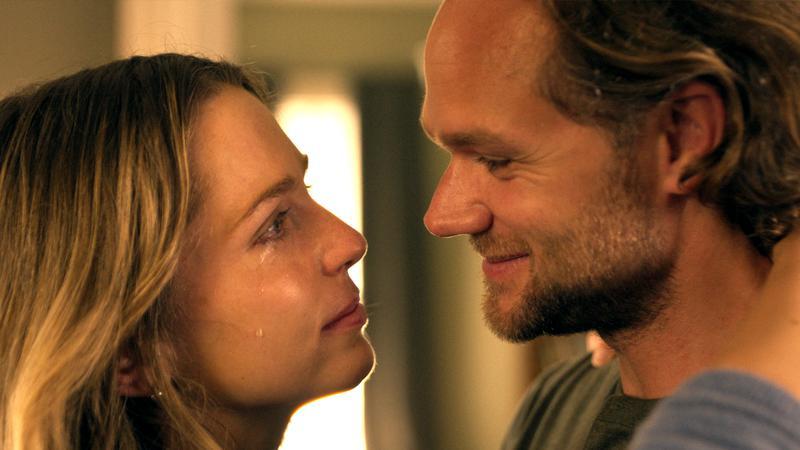
The Events Unfolding In Affection Will Make You Question What's Right & What's Wrong.
- The Direct: "Elaborating on morality, how did you approach playing Bruce, knowing that the character was someone half the audience would sympathize with, and half were going to deeply hate very quickly?"
Joseph Cross: Yeah. I mean, look, my only job is just to understand why he's doing what he's doing, and just to say... Without giving too much away, this thing happened in his life. He lost the life that he had. He believes he has the capacity to return it to what it was, not just for himself, but for his daughter, and his wife, and the family as a unit. And he thinks that purpose, come hell or high water, justifies, you know, the end justifies the means.
Affection wastes no time letting audiences in on what's really happening. We will avoid specific details here, but at the end of the day, the events of the film are caused by Bruce's inability to cope with grief and trying to right a wrong, no matter the consequences or questionable morality behind it all.
Despite what viewers witness in the film, Cross put his foot down in saying that "Bruce, to me, is not a psychopath," and "he's not a sociopath:"
Cross: Bruce, to me, is not a psychopath. He's not a sociopath. I think that you can see the toll this is taking on him. Actually, I think this is very difficult for him every time when he thinks that he's figured it out and hasn't, and what he has to go through to restart. I think it's brutalizing for him, and I think that's where his humanity has gotten stripped away. I think that what he's done is corrosive to him, and it makes him more and more desperate. He keeps doubling down and tripling down and pushing further and further toward this—because he can't just be like, well, I got a rough shake here. You know what I mean? Like, I got a tough hand, and it was horrible, and it was miserable. And I'm going to figure out how to grieve.
asd
Cross: Bruce clearly has not heard the old adage, 'If you love something, let it go.' I mean, that's not something he's capable of. I think that something about just love in life in general is like change is the only constant, right? It's like the only thing that we can count on is that everything is going to change, and everything is ephemeral, and no one is going to be ours forever in the way that we initially found them. And these are the things that Bruce really struggles [with]. These are not his strong points. He does not have the capacity to accept these things.
- The Direct: "How did you approach tackling such heavy questions on morality in these intense situations, while trying to make sure everyone in the film was still understandable and also able to be sympathized with?"
BT Meza: There are a lot of morality issues in this film. You know, not going too deep into the Sci-Fi aspect of it, but there's a lot of morality just in the Sci Fi aspect of it, not to mention the morality of what Bruce is doing and what he believes he's doing, you know, in the name of love, but what he's really doing and what that means for him as a person, it breaks you down over time. Even for somebody like him, who believes he's doing something for the most just cause, which is saving his family, it still takes a toll, because the morality of it over time erodes you.
- The Direct: "I want to talk about the idea of false memories and just how terrifying they are. I mean, when you're dreaming, you fully believe that that's your reality, and to know that your brain can trick you into something like that is terrifying. Does that ever keep you up at night?"
Cross: I mean, that's a great sort of way into this story. I mean, it makes you think about mental illness, and when somebody's convinced of something that's not actually happening, and the danger they can put themselves in and others in, like you said about dreams. I mean, I was dreaming so much last night for some reason. I don't know if this happens to you, but if I wake up and then I go back to sleep, if I wake up at like four or five, then go back to sleep until like six or seven, those dreams are super vivid. I mean, you're entirely convinced during the dream that you're dreaming.