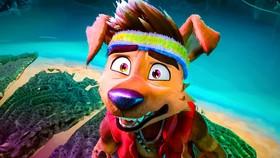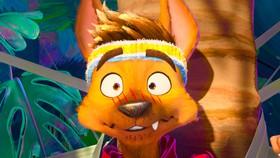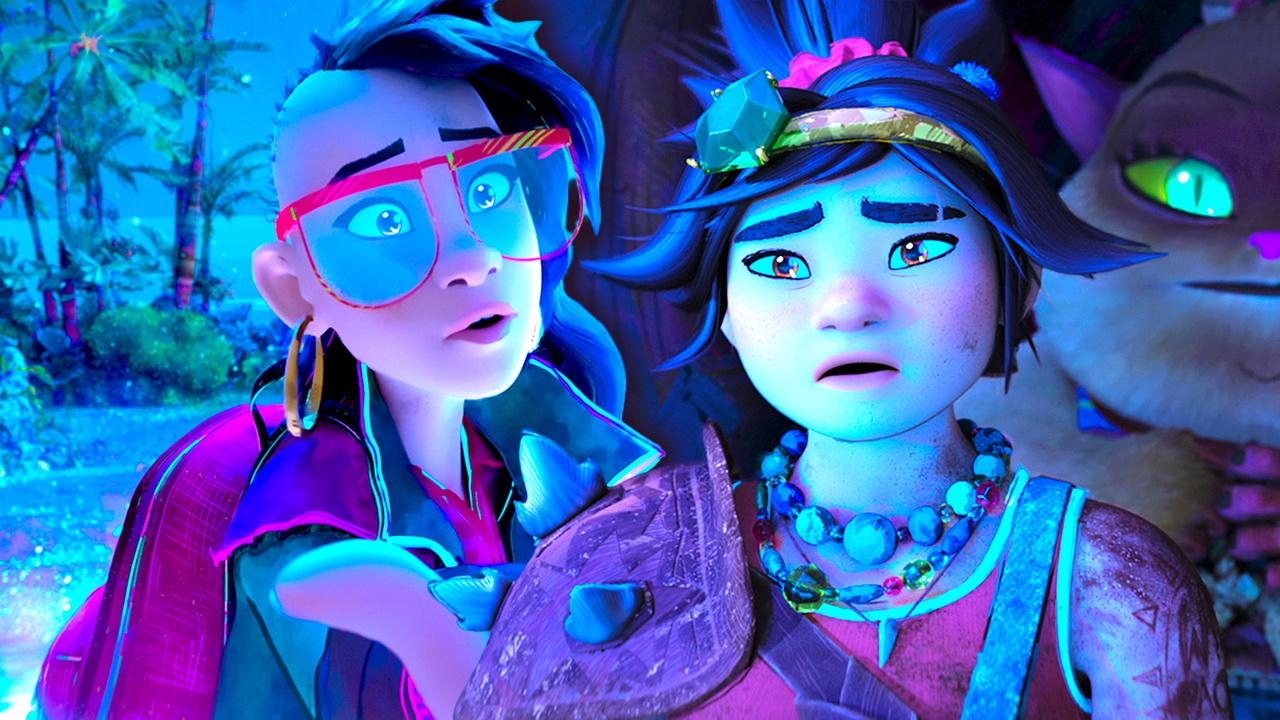
DreamWorks' latest animated adventure, Forgotten Island, is being hailed as one of the studio's best films from the last decade, and a big reason for that is its incredibly emotional ending. The movie, currently in theaters, follows Jo (H.E.R.) and Raissa (Liza Soberano), two friends who discover Nakali, a mystical place where they have an amazing, unforgettable time. However, the duo soon embarks on a quest to recover their memories and find a way back home while avoiding the dreaded manananggal.
Helping them on that journey is Dave Franco's Raww, their self-appointed guide around the island. Though, as revealed in the last act, Raww's presence wasn't a coincidence. It turns out that he was sent by Jenny Slate's Batiba, a memory demon looking to expand her collection by stealing visitors' memories.
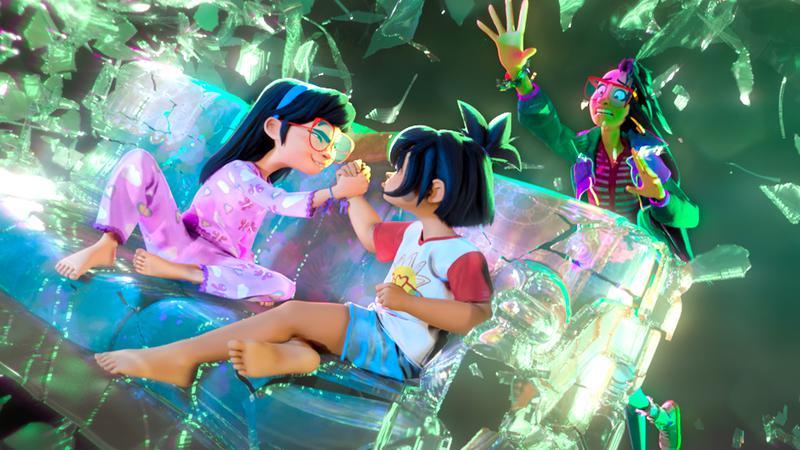
In the film's climactic final act, as Jo is about to lose all memories of her best friend, Raissa finds her way back to Nakali and into the sleep demon's trance to save their friendship. What follows is a heartbreaking, emotional sequence in which Raissa races through their shared memories as they shatter and fade around her. Thankfully, this film has a happy ending, and their friendship proves strong enough to save Jo's memories from the void, pulling them out of Batiba's grasp. The whole ordeal even gives Batiba a new outlook on life.
The Direct spoke with Forgotten Island directors Joel Crawford and Januel P. Mercado, who broke down the film's emotional ending, their Christopher Nolan influences, and how the ending sequence was one of their non-negotiables.
Forgotten Island's Powerful & Emotional Ending Was Inspired by Christopher Nolan
The Trauma of Seeing Their Friendship Vanish
- The Direct: "When it comes to these movies, it's that big climax moment, that punch in the gut, that is so important. Talk to me about how you approach the scenes where Raissa is going through Jo's memories as they kind of vanish, and just juggling that. Because there's got to be so much pressure, making sure you pull it off and not messing up. Especially when it's such an abstract idea like that."
Januel P. Mercado: We're inspired by many filmmakers, and your question reminded me of Christopher Nolan. We look up to him as a filmmaker, and we always joke around a lot when we were playing with the structure and that gut punch you're talking about. But we always talk about 'The Prestige,' you know, because you have The Pledge, which is the setup. You have The Turn, where you make it disappear, but it's not enough to make it disappear, right? You've got to bring it back. That's The Pledge.
Mercado noted how the climax was "building emotionally to this relationship that you've invested the whole movie in, and to see it disappear in front of your eyes:"
Mercado: And so when you talk about that climax, it's building emotionally to this relationship that you've invested the whole movie in, and to see it just disappear in front of your eyes and just be left there with nothing, and be sitting there with that emotional kind of payoff, and then 'The Prestige' of like it being returned back to you is such a cathartic release that that was something that we were thinking. Like this is the story. This is why we make movies. To bring people along with you, feel everything, and then come out with joy at the end.
Joel Crawford jumped in to explain that, at the end of the day, a movie and its script will evolve throughout the process before revealing what it really wants to be about:
Joel Crawford: There are certain things that you understand when you're telling a story. That it will evolve and change, and by the time you get to the end of a script, you've kind of learned what the movie really wants to be about, and then you start over. I remember going into the first screening—We put up the movie in just rough storyboards every few months to just see how it plays as a story.
Crawford revealed that the emotional ending, and exactly how it played out, was one of their "non-negotiable things" when it came to making this movie:
Crawford: And there are a few non-negotiable things where the whole reason we're telling the story was building to this moment of Raissa experiencing these memories and getting a different perspective and something she never understood before, and talking to little Jo. And for us, that is the movie. It's a culmination of the movie, right in that moment when Raissa is talking to little Jo as she's disappearing...
"If there are any notes about taking this out, then there's no movie," he noted:
Crawford: And we said, if there are any notes about taking this out, then there's no movie. And we can't do this. And it's not like a stubborn thing, it's just like an authentic thing. Thankfully, everybody was like, 'We love this.' But to know which things are worth fighting for... and then what's great about knowing that so early, of the north star of why you're telling the story, that allowed us to keep iterating...
Crawford then highlighted how amazing it was to work with all the creatives involved with Forgotten Island:
Crawford: Being able to work with our cinematography, our head of cinematography, Scott Colin, to find just the right way to visualize and push these memories, our animators to tap into kind of the the tragic quiet of the moment where Raissa is talking to Little Jo. It's a beautiful thing when you know why you're telling something, and you communicate that to all the talented people working on the movie. [Where] it evolves into a bigger thing than you ever pictured. Everyone sees the vision and is excited by it.
The Direct's full spoiler-filled conversation with Forgotten Island's directors, Joel Crawford and Januel P. Mercado, is below: